It shows up in almost every heated group chat — but what is it actually saying?
You’ve probably seen the fuming emoji pop up after a frustrating text, a savage comeback, or a chaotic group chat moment. It shows up everywhere, from WhatsApp arguments to Instagram captions and TikTok comment sections. But the meaning behind it isn’t always as simple as “I’m mad.” Emoji meaning can shift depending on the conversation, the relationship, the tone, the platform, and even the culture of the people texting.
The fuming emoji turns raw frustration into something you can send in one quick tap.
What do fuming emoji mean?
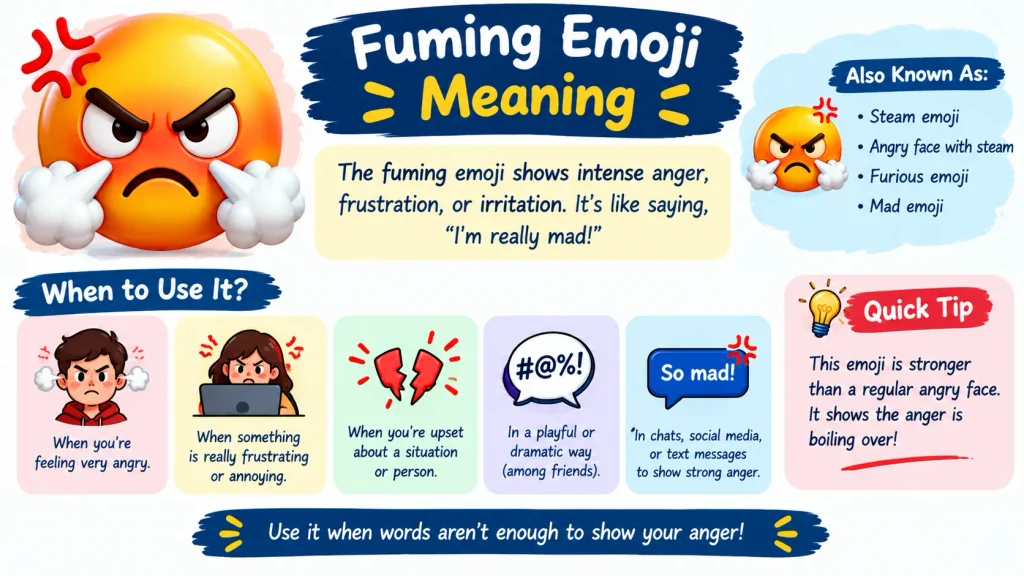
The fuming emoji family covers a range of feelings, from mild annoyance to full-blown rage. 😤 itself, the “Face with Steam From Nose,” is often used for frustration, determination, or a dramatic “hmph” moment, not always real anger.
Other emojis in this family, like 😡 and 🤬, are much more intense and usually signal genuine anger or outrage. Softer ones, like 🙄 and 😒, lean more toward annoyance or sarcasm than actual fury.
Context is everything here. The same emoji can mean “I’m playfully annoyed” in one chat and “I’m genuinely furious” in another.
| Emoji | Core meaning | Misread as | Best used when |
|---|---|---|---|
| 😤 | Frustration or determination | Real, serious anger | Venting about something small or showing you’re pushing through |
| 😡 | Strong anger | Mild annoyance | You want to show you’re genuinely upset |
| 😠 | General anger or irritation | Sadness | Reacting to something unfair or annoying |
| 🤬 | Extreme anger, cursing | A joke or exaggeration | Dramatic, over-the-top reactions among friends |
| 💢 | Anger or tension building up | Physical pain | Adding emphasis to another angry emoji |
| 👿 | Mischievous or intense anger | Actual evil intent | Joking about “villain mode” or dramatic fury |
| 😾 | Grumpy, pouting anger | Genuine hostility | Playful complaining or grumpy-cat energy |
| 🙄 | Sarcasm or mild annoyance | Boredom | Reacting to something eye-roll-worthy |
| 😒 | Unimpressed or annoyed | Sadness | Calling out something disappointing |
| 😖 | Frustrated discomfort | Physical pain | Venting about a stressful or annoying situation |
😤 Face with Steam From Nose
Meaning: Shows frustration, determination, or a dramatic huff, more often playful than truly angry.
Example 1: I studied for six hours straight 😤 nothing is stopping me from passing this exam.
Example 2: He ate my leftovers again 😤 I’m not even mad, just disappointed.
😡 Pouting Face
Meaning: Represents strong, clear anger about something specific.
Example 1: They canceled my flight last minute 😡 I have never been this upset.
Example 2: She read my message and didn’t reply for three days 😡
😠 Angry Face
Meaning: General irritation or anger, slightly less intense than 😡.
Example 1: My neighbor’s dog barked all night again 😠
Example 2: Traffic made me late for the interview 😠 today is not my day.
🤬 Face with Symbols on Mouth
Meaning: Extreme anger, often used dramatically or humorously to imply someone is cursing.
Example 1: He spilled coffee on my laptop right before the meeting 🤬
Example 2: I just found out the concert sold out in two minutes 🤬
💢 Anger Symbol
Meaning: A visual burst of frustration, usually paired with another emoji to add intensity.
Example 1: She keeps leaving me on read 😡💢
Example 2: My internet crashed during the final round 💢 of all times.
👿 Angry Face with Horns
Meaning: Shows mischievous or dramatic anger, often used jokingly instead of seriously.
Example 1: Watch out, exam mode 👿 activated for the next three hours.
Example 2: He ate the last slice of pizza, so now it’s revenge time 👿
😾 Pouting Cat Face
Meaning: A cute but grumpy way to express annoyance, often used playfully.
Example 1: Woke up an hour early for nothing 😾
Example 2: My favorite show got cancelled 😾 I’m not okay.
🙄 Face with Rolling Eyes
Meaning: Sarcastic or unimpressed reaction to something annoying.
Example 1: He said he’d be five minutes 🙄 that was an hour ago.
Example 2: “I totally didn’t forget your birthday” 🙄 sure you didn’t.
😒 Unamused Face
Meaning: A flat, unimpressed reaction to something disappointing or annoying.
Example 1: They rescheduled the meeting for the third time 😒
Example 2: He said he’d call back and never did 😒
😖 Confounded Face
Meaning: Frustrated discomfort, often about a stressful or overwhelming situation.
Example 1: I have three deadlines due tomorrow 😖
Example 2: My phone died right in the middle of the call 😖
How to use fuming emoji the right way
On WhatsApp, fuming emoji usually show up in personal, casual chats where friends or family are venting about everyday frustrations.
Example: “The bus left without me again 😤 I need a car.”
On Instagram, these emojis appear in captions, stories, and bios to add personality, humor, or dramatic flair to a post.
Example: A caption reading “Monday mood 😤” under a photo of someone rushing to work.
TikTok
On TikTok, fuming emoji are common in comments and captions, often used sarcastically, humorously, or as part of a trending reaction.
Example: A comment saying “the way this video called me out 😭😡” under a relatable video.
Do
- Use emojis that match the message.
- Consider the relationship and context.
- Keep combinations natural.
- Use emojis to support the message.
Don’t
- Do not overuse emojis.
- Do not assume every person interprets them identically.
- Do not use unrelated emojis.
- Do not force emoji combinations into serious conversations.
Best fuming emoji combos — copy & paste
Romantic
- 😤😡 — Use this when you’re playfully “mad” about how much you like someone.
- 😠👿 — A teasing way to say someone has stolen your heart against your will.
- 💢😤 — For joking that your feelings for someone are “out of control.”
Cute
- 😾😤 — For a grumpy-cat pout when someone’s being adorable.
- 🙄😒 — A cute, playful eye-roll at something sweet someone did.
- 😤🙄 — For a cute little “hmph” moment.
Flirty
- 😡😤 — For a flirty text like “you make me so mad, in a good way.”
- 👿😒 — A playful tease implying someone’s trouble.
- 😠💢 — For teasing someone who won’t stop being charming.
Missing Someone
- 😤💢 — For expressing frustration about how much you miss someone.
- 😖😒 — For showing restless annoyance from missing them.
- 🙄😤 — A playful complaint about missing someone too much.
Good Night
- 😤😒 — For a playful goodnight after a silly disagreement.
- 😾🙄 — A grumpy but affectionate goodnight message.
- 😠😤 — For saying goodnight right after teasing each other.
Trending fuming emoji in 2026
Right now, 😤, 😡, 🤬, and 💢 are some of the most commonly used emojis in this family. People reach for them to express frustration in a way that feels expressive but still lighthearted.
Younger users, especially on TikTok and Instagram, often use these emojis ironically, turning small annoyances into dramatic, funny reactions rather than showing real anger. Creators frequently use them in captions or comment replies to react to relatable, everyday frustrations.
| Emoji | Why trending | Who uses it | Platform |
|---|---|---|---|
| 😤 | Adds dramatic flair to small frustrations | Younger users, content creators | TikTok, Instagram |
| 😡 | Clearly signals genuine annoyance or anger | General users across age groups | WhatsApp, Instagram |
| 🤬 | Used for humorous, exaggerated reactions | TikTok commenters, meme accounts | TikTok |
| 💢 | Adds intensity to other angry emojis | Casual chat users | WhatsApp, Instagram |
Emoji usage naturally shifts over time as new trends, combinations, and inside jokes emerge across different platforms.
FAQ
What is the most popular fuming emoji?
😤 is one of the most widely used fuming emoji. People often reach for it to express frustration or determination without sounding too serious.
What does 😤 mean from a girl or boy?
The meaning of 😤 depends more on the context, relationship, and tone of the conversation than on who sends it. Gender doesn’t change what it means.
Why do emojis look different on iPhone vs Android?
Each platform designs its own visual style for emojis. The underlying meaning stays the same, but the images can look noticeably different.
Are fuming emoji used differently in other countries?
Yes, culture, language, and local online communities can all shape how people use and interpret fuming emoji, even though the core meaning stays similar.
Conclusion
The fuming emoji family gives you a quick, expressive way to show frustration, whether it’s serious or playful. Used the right way, these emojis add personality and emotion to everyday conversations. Just remember that context always shapes how they’re read.

Abdullah Kharal is the creator of World Content Press, a platform dedicated to emojis, symbols, and digital expressions.
He creates helpful content to make it easier for readers to discover, understand, copy, and share emojis.
His goal is to build a useful and enjoyable resource for everyone who loves expressing themselves online